





Hassan Shahmohammadiaka Fittar

R&D Research Scientist at Q.ANT·Stuttgart, Germany

Hassan Shahmohammadi

I love connecting ideas across distant fields, from language and audio processing to physics and biology.

Portrait of Hassan Shahmohammadi

About

Connecting the dots

  1. Language
  2. Vision
  3. Audio
  4. Physics & Photonic Processing

What excites me most is connecting different domains. My PhD at the University of Tübingen and IMPRS-IS was about bridging language and vision. At Sony Europe I brought audio into the mix, working on audio and speech language models. Now, as an R&D research scientist at Q.ANT in Stuttgart, I have moved into physics and photonic processing, working at the intersection of AI and photonic chip design.

Beyond AI, I am fascinated by biology, electronics and physics. I like to be creative, build things with my own hands, and find unexpected links between ideas. In my free time, I also do sports, make handcrafts, and learn new languages.

Experience

Where I've been

  1. WorkOct 2026 — Present· 2 mos

    Senior Research Scientist

    Q.ANT Stuttgart, Germany

    R&D at the intersection of AI and photonic processing.

  2. WorkMay 2024 — Sep 2026· 2 yrs 5 mos

    Senior Research Scientist

    Sony Europe Stuttgart, Germany

    Research on audio and speech language models.

  3. EducationJan 2020 — Apr 2024· 4 yrs 4 mos

    PhD in Computer Science (ML & NLP)

    University of Tübingen · IMPRS-IS Tübingen, Germany

    Thesis: Language Grounding to Vision.

  4. WorkAug 2017 — Aug 2019· 2 yrs 1 mo

    Programmer

    ParsCoders Iran

    • Machine learning fundamentals
    • Text classification & semantic word / sentence embeddings
    • Object detection & text–image retrieval
  5. EducationSep 2016 — Jan 2019· 2 yrs 5 mos

    MSc in Computer Science (AI)

    Bu-Ali Sina University Hamedan, Iran

    Thesis: Paraphrase Detection Using Deep Learning Techniques.

Research

Featured publications

All publications
Interspeech 2026Conference

ALARM: Audio-Language Alignment for Reasoning Models

Petr Grinberg, Hassan Shahmohammadi

Interspeech 2026 (Long Track)

Abstract

Large audio language models (ALMs) extend LLMs with auditory understanding. A common approach freezes the LLM and trains only an adapter on self-generated targets. However, this fails for reasoning LLMs (RLMs) whose built-in chain-of-thought traces expose the textual surrogate input, yielding unnatural responses. We propose self-rephrasing, converting self-generated responses into audio-understanding variants compatible with RLMs while preserving distributional alignment. We further fuse and compress multiple audio encoders for stronger representations. For training, we construct a 6M-instance multi-task corpus (2.5M unique prompts) spanning 19K hours of speech, music, and sound. Our 4B-parameter ALM outperforms similarly sized models and surpasses most larger ALMs on related audio-reasoning benchmarks, while preserving textual capabilities with a low training cost. Notably, we achieve the best open-source result on the MMAU-speech and MMSU benchmarks and rank third among all the models.
EMNLP 2023Conference Outstanding Paper Award

ViPE: Visualise Pretty-much Everything

Hassan Shahmohammadi, Adhiraj Ghosh, Hendrik P. A. Lensch

Proceedings of the 2023 Conference on Empirical Methods in Natural Language Processing

Abstract

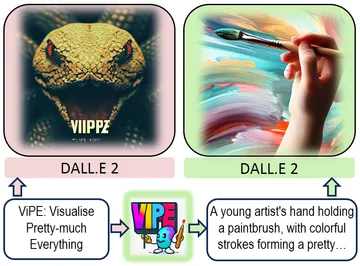
Figurative and non-literal expressions are profoundly integrated in human communication. Visualising such expressions allow us to convey our creative thoughts, and evoke nuanced emotions. Recent text-to-image models like Stable Diffusion, on the other hand, struggle to depict non-literal expressions. Recent works primarily deal with this issue by compiling humanly annotated datasets on a small scale, which not only demands specialised expertise but also proves highly inefficient. To address this issue, we introduce ViPE, Visualise Pretty-much Everything. ViPE offers a series of lightweight and robust language models that have been trained on a large-scale set of lyrics with noisy visual descriptions that represent their implicit meaning. The synthetic visual descriptions are generated by GPT3.5 relying on neither human annotations nor images. ViPE effectively expresses any arbitrary piece of text into a visualisable description, enabling meaningful and high-quality image generation. We provide compelling evidence that ViPE is more robust than GPT3.5 in synthesising visual elaborations. ViPE also exhibits an understanding of figurative expressions comparable to human experts, providing a powerful and open-source backbone to many downstream applications such as music video and caption generation.

Behavior Research MethodsJournal

Language with Vision: a Study on Grounded Word and Sentence Embeddings

Hassan Shahmohammadi, Maria Heitmeier, Elnaz Shafaei-Bajestan, Hendrik P. A. Lensch, R. Harald Baayen

Behavior Research Methods

Abstract

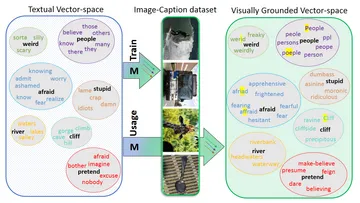
Grounding language in vision is an active field of research seeking to construct cognitively plausible word and sentence representations by incorporating perceptual knowledge from vision into text-based representations. Despite many attempts at language grounding, achieving an optimal equilibrium between textual representations of the language and our embodied experiences remains an open field. Some common concerns are the following. Is visual grounding advantageous for abstract words, or is its effectiveness restricted to concrete words? What is the optimal way of bridging the gap between text and vision? To what extent is perceptual knowledge from images advantageous for acquiring high-quality embeddings? Leveraging the current advances in machine learning and natural language processing, the present study addresses these questions by proposing a simple yet very effective computational grounding model for pre-trained word embeddings. Our model effectively balances the interplay between language and vision by aligning textual embeddings with visual information while simultaneously preserving the distributional statistics that characterize word usage in text corpora. By applying a learned alignment, we are able to indirectly ground unseen words including abstract words. A series of evaluations on a range of behavioural datasets shows that visual grounding is beneficial not only for concrete words but also for abstract words, lending support to the indirect theory of abstract concepts. Moreover, our approach offers advantages for contextualized embeddings, such as those generated by BERT, but only when trained on corpora of modest, cognitively plausible sizes.

CoNLL 2021Conference

Learning Zero-Shot Multifaceted Visually Grounded Word Embeddings via Multi-Task Training

Hassan Shahmohammadi, Hendrik P. A. Lensch, R. Harald Baayen

Proceedings of the 25th Conference on Computational Natural Language Learning (CoNLL) @ EMNLP

Abstract

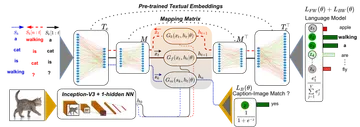
Language grounding aims at linking the symbolic representation of language (e.g., words) into the rich perceptual knowledge of the outside world. The general approach is to embed both textual and visual information into a common space — the grounded space — confined by an explicit relationship. We argue that since concrete and abstract words are processed differently in the brain, such approaches sacrifice the abstract knowledge obtained from textual statistics in the process of acquiring perceptual information. The focus of this paper is to solve this issue by implicitly grounding the word embeddings. Rather than learning two mappings into a joint space, our approach integrates modalities by implicit alignment. This is achieved by learning a reversible mapping between the textual and the grounded space by means of multi-task training. Intrinsic and extrinsic evaluations show that our way of visual grounding is highly beneficial for both abstract and concrete words. Our embeddings are correlated with human judgments and outperform previous works using pretrained word embeddings on a wide range of benchmarks.

Let's work together

Interested in collaborating, have a question about my research, or just want to say hi? My inbox is open.

Get in touch