Hassan Shahmohammadiaka Fittar

Research

Publications

Papers on multimodal learning, audio-language models, visual grounding of language and NLP. For an up-to-date list, see my Google Scholar.

2026

Interspeech 2026Conference

ALARM: Audio-Language Alignment for Reasoning Models

Petr Grinberg, Hassan Shahmohammadi

Interspeech 2026 (Long Track)

Abstract

Large audio language models (ALMs) extend LLMs with auditory understanding. A common approach freezes the LLM and trains only an adapter on self-generated targets. However, this fails for reasoning LLMs (RLMs) whose built-in chain-of-thought traces expose the textual surrogate input, yielding unnatural responses. We propose self-rephrasing, converting self-generated responses into audio-understanding variants compatible with RLMs while preserving distributional alignment. We further fuse and compress multiple audio encoders for stronger representations. For training, we construct a 6M-instance multi-task corpus (2.5M unique prompts) spanning 19K hours of speech, music, and sound. Our 4B-parameter ALM outperforms similarly sized models and surpasses most larger ALMs on related audio-reasoning benchmarks, while preserving textual capabilities with a low training cost. Notably, we achieve the best open-source result on the MMAU-speech and MMSU benchmarks and rank third among all the models.
2023

EMNLP 2023Conference Outstanding Paper Award

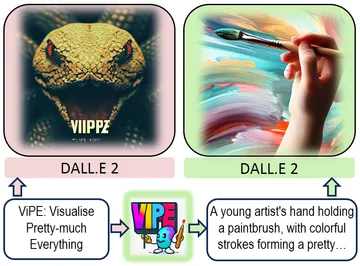
ViPE: Visualise Pretty-much Everything

Hassan Shahmohammadi, Adhiraj Ghosh, Hendrik P. A. Lensch

Proceedings of the 2023 Conference on Empirical Methods in Natural Language Processing

Abstract

Figurative and non-literal expressions are profoundly integrated in human communication. Visualising such expressions allow us to convey our creative thoughts, and evoke nuanced emotions. Recent text-to-image models like Stable Diffusion, on the other hand, struggle to depict non-literal expressions. Recent works primarily deal with this issue by compiling humanly annotated datasets on a small scale, which not only demands specialised expertise but also proves highly inefficient. To address this issue, we introduce ViPE, Visualise Pretty-much Everything. ViPE offers a series of lightweight and robust language models that have been trained on a large-scale set of lyrics with noisy visual descriptions that represent their implicit meaning. The synthetic visual descriptions are generated by GPT3.5 relying on neither human annotations nor images. ViPE effectively expresses any arbitrary piece of text into a visualisable description, enabling meaningful and high-quality image generation. We provide compelling evidence that ViPE is more robust than GPT3.5 in synthesising visual elaborations. ViPE also exhibits an understanding of figurative expressions comparable to human experts, providing a powerful and open-source backbone to many downstream applications such as music video and caption generation.

Behavior Research MethodsJournal

Language with Vision: a Study on Grounded Word and Sentence Embeddings

Hassan Shahmohammadi, Maria Heitmeier, Elnaz Shafaei-Bajestan, Hendrik P. A. Lensch, R. Harald Baayen

Behavior Research Methods

Abstract

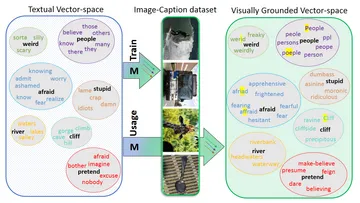
Grounding language in vision is an active field of research seeking to construct cognitively plausible word and sentence representations by incorporating perceptual knowledge from vision into text-based representations. Despite many attempts at language grounding, achieving an optimal equilibrium between textual representations of the language and our embodied experiences remains an open field. Some common concerns are the following. Is visual grounding advantageous for abstract words, or is its effectiveness restricted to concrete words? What is the optimal way of bridging the gap between text and vision? To what extent is perceptual knowledge from images advantageous for acquiring high-quality embeddings? Leveraging the current advances in machine learning and natural language processing, the present study addresses these questions by proposing a simple yet very effective computational grounding model for pre-trained word embeddings. Our model effectively balances the interplay between language and vision by aligning textual embeddings with visual information while simultaneously preserving the distributional statistics that characterize word usage in text corpora. By applying a learned alignment, we are able to indirectly ground unseen words including abstract words. A series of evaluations on a range of behavioural datasets shows that visual grounding is beneficial not only for concrete words but also for abstract words, lending support to the indirect theory of abstract concepts. Moreover, our approach offers advantages for contextualized embeddings, such as those generated by BERT, but only when trained on corpora of modest, cognitively plausible sizes.

2022

The Mental LexiconJournal

How direct is the link between words and images?

Hassan Shahmohammadi, Maria Heitmeier, Elnaz Shafaei-Bajestan, Hendrik P. A. Lensch, R. Harald Baayen

The Mental Lexicon

Abstract

Current word embedding models despite their success, still suffer from their lack of grounding in the real world. In this line of research, Günther et al. 2022 proposed a behavioral experiment to investigate the relationship between words and images. In their setup, participants were presented with a target noun and a pair of images, one chosen by their model and another chosen randomly. Participants were asked to select the image that best matched the target noun. In most cases, participants preferred the image selected by the model. Günther et al., therefore, concluded the possibility of a direct link between words and embodied experience. We took their experiment as a point of departure and addressed the following questions. 1. Apart from utilizing visually embodied simulation of given images, what other strategies might subjects have used to solve this task? To what extent does this setup rely on visual information from images? Can it be solved using purely textual representations? 2. Do current visually grounded embeddings explain subjects’ selection behavior better than textual embeddings? 3. Does visual grounding improve the semantic representations of both concrete and abstract words? To address these questions, we designed novel experiments by using pre-trained textual and visually grounded word embeddings. Our experiments reveal that subjects’ selection behavior is explained to a large extent based on purely text-based embeddings and word-based similarities, suggesting a minor involvement of active embodied experiences. Visually grounded embeddings offered modest advantages over textual embeddings only in certain cases. These findings indicate that the experiment by Günther et al. may not be well suited for tapping into the perceptual experience of participants, and therefore the extent to which it measures visually grounded knowledge is unclear.

2021

CoNLL 2021Conference

Learning Zero-Shot Multifaceted Visually Grounded Word Embeddings via Multi-Task Training

Hassan Shahmohammadi, Hendrik P. A. Lensch, R. Harald Baayen

Proceedings of the 25th Conference on Computational Natural Language Learning (CoNLL) @ EMNLP

Abstract

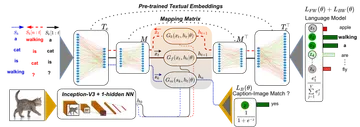
Language grounding aims at linking the symbolic representation of language (e.g., words) into the rich perceptual knowledge of the outside world. The general approach is to embed both textual and visual information into a common space — the grounded space — confined by an explicit relationship. We argue that since concrete and abstract words are processed differently in the brain, such approaches sacrifice the abstract knowledge obtained from textual statistics in the process of acquiring perceptual information. The focus of this paper is to solve this issue by implicitly grounding the word embeddings. Rather than learning two mappings into a joint space, our approach integrates modalities by implicit alignment. This is achieved by learning a reversible mapping between the textual and the grounded space by means of multi-task training. Intrinsic and extrinsic evaluations show that our way of visual grounding is highly beneficial for both abstract and concrete words. Our embeddings are correlated with human judgments and outperform previous works using pretrained word embeddings on a wide range of benchmarks.